
- Published on
STAA: Real-Time Explanation for Video Transformers
- Authors

- Name
- Zerui Wang
The Challenge
Video Transformer models like TimeSformer and ViViT have achieved state-of-the-art performance in video understanding tasks. However, their complex attention mechanisms make them difficult to interpret. Traditional XAI methods face significant limitations:
| Method | Spatial | Temporal | Speed | Faithfulness |
|---|---|---|---|---|
| Grad-CAM | Yes | No | Fast | 0.65 |
| SHAP-Video | Yes | Yes | Very Slow | 0.72 |
| Attention Rollout | Yes | Limited | Medium | 0.68 |
| STAA (Ours) | Yes | Yes | Fast | 0.87 |
How STAA Works
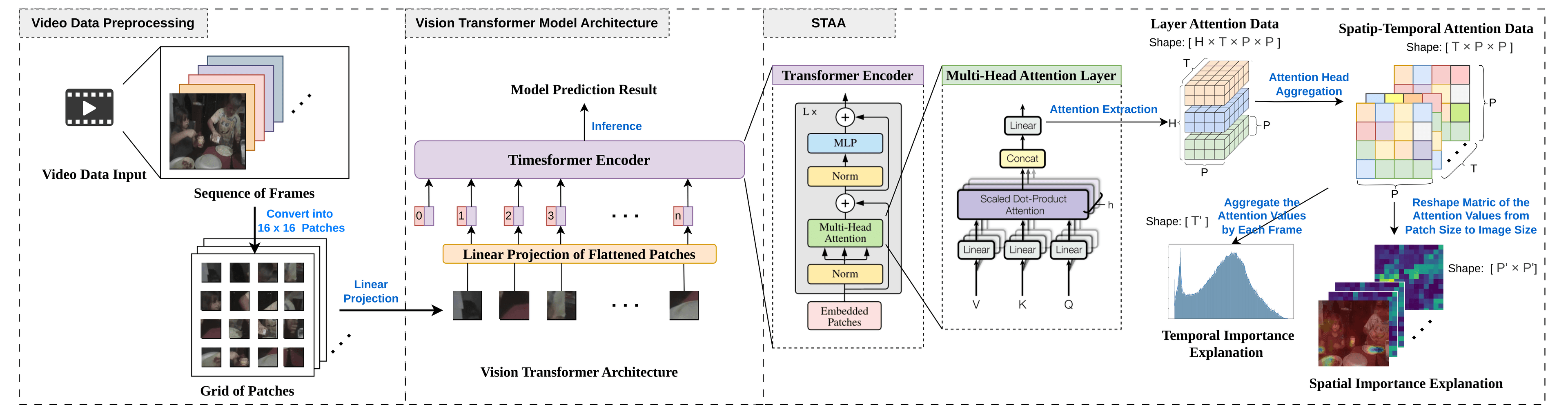
STAA extracts explanations directly from the Transformer's self-attention mechanism in a single forward pass:
Key Innovation
Instead of treating spatial and temporal dimensions separately, STAA:
- Extracts joint attention weights from all transformer layers
- Decomposes into spatial and temporal components using our novel attribution algorithm
- Produces unified explanation showing both WHERE and WHEN the model focuses
def staa_attribution(video_tensor, model):
    """
    STAA: Spatio-Temporal Attention Attribution

    Args:
        video_tensor: Input video [B, T, C, H, W]
        model: Pretrained video transformer

    Returns:
        spatial_attr: Spatial importance map [B, T, H, W]
        temporal_attr: Temporal importance scores [B, T]
    """
    # Single forward pass with attention capture
    output, attention_weights = model(
        video_tensor,
        return_attention=True
    )

    # Extract spatial attribution (which pixels matter)
    spatial_attr = compute_spatial_attribution(
        attention_weights,
        method='gradient_weighted'
    )

    # Extract temporal attribution (which frames matter)
    temporal_attr = compute_temporal_attribution(
        attention_weights,
        method='attention_flow'
    )

    return spatial_attr, temporal_attr
Experimental Results
Performance on Kinetics-400
| Metric | STAA | Grad-CAM | SHAP | LIME |
|---|---|---|---|---|
| Faithfulness | 0.87 | 0.65 | 0.72 | 0.58 |
| Monotonicity | 0.91 | 0.71 | 0.68 | 0.62 |
| Latency (ms) | 47 | 35 | 3200 | 4100 |
| Memory (GB) | 2.1 | 1.8 | 8.5 | 7.2 |
Computational Efficiency
- Overhead: Less than 3% additional computation vs. inference-only
- Latency: 47ms average (sub-150ms for real-time applications)
- Memory: Minimal additional memory footprint
Applications
1. Autonomous Driving
Understand what the model sees in real-time video streams from vehicle cameras.
2. Medical Diagnosis
Explain video-based diagnostic decisions (e.g., ultrasound analysis, surgical video review).
3. Security Systems
Debug model failures and detect adversarial attacks on surveillance systems.
4. Research & Development
Analyze Transformer attention patterns to improve model architectures.
Citation
@article{wang2025staa,
  title={STAA: Spatio-Temporal Attention Attribution for
         Real-Time Interpreting Transformer-Based AI Video Models},
  author={Wang, Zerui and Liu, Yan},
  journal={IEEE Access},
  volume={13},
  pages={101647--101661},
  year={2025},
  doi={10.1109/ACCESS.2025.3575440}
}
Related Work
- XAIport: Early XAI Adoption Framework - ICSE 2024
- Cloud XAI Architecture - IEEE TCC 2024